
We Ask the Wrong Questions About Innovative Schools
What early experiments in human-centered learning still have to teach us

Click the ♥️!
If you generously pre-ordered People-Based Learning, thank you! You are a FOUNDING READER, and I have a little giveaway and something for you. Just kindly fill out this form.
Before the world slowed down, before the pandemic paused so many experiments in learning, we were buzzing with big visions of what school could be.
We imagined learning spaces alive with curiosity and agency. Schools that felt human. Places with the hum of collaboration instead of the silence of compliance.
In 2018, I was part of a group that co-founded what we called the Innovative Schools Cooperative. Led by a school leader in Brooklyn, Andrew Ravin, and others across schools. we represented about ten newly launched, or just-about-to-launch, schools. We gathered for the first time at Columbia University’s Teachers College, where made a two-minute video, full of optimism and belief.
This was pre-Zoom. Pre-“learning loss.” Pre-AI explosion. What we did have was a near-relentless conviction that we were standing at the beginning of a new era in education.
Revolution School, Hudson Lab School, Workshop Middle School, Portfolio School, Brightworks, Millennium School. There were many different versions.
Our collective question:
What happens when bold educational experiments don’t “scale,” but still change everyone who touched them?
We came from far corners of the country, but we were united by a shared refusal to accept schooling as fixed or inevitable.
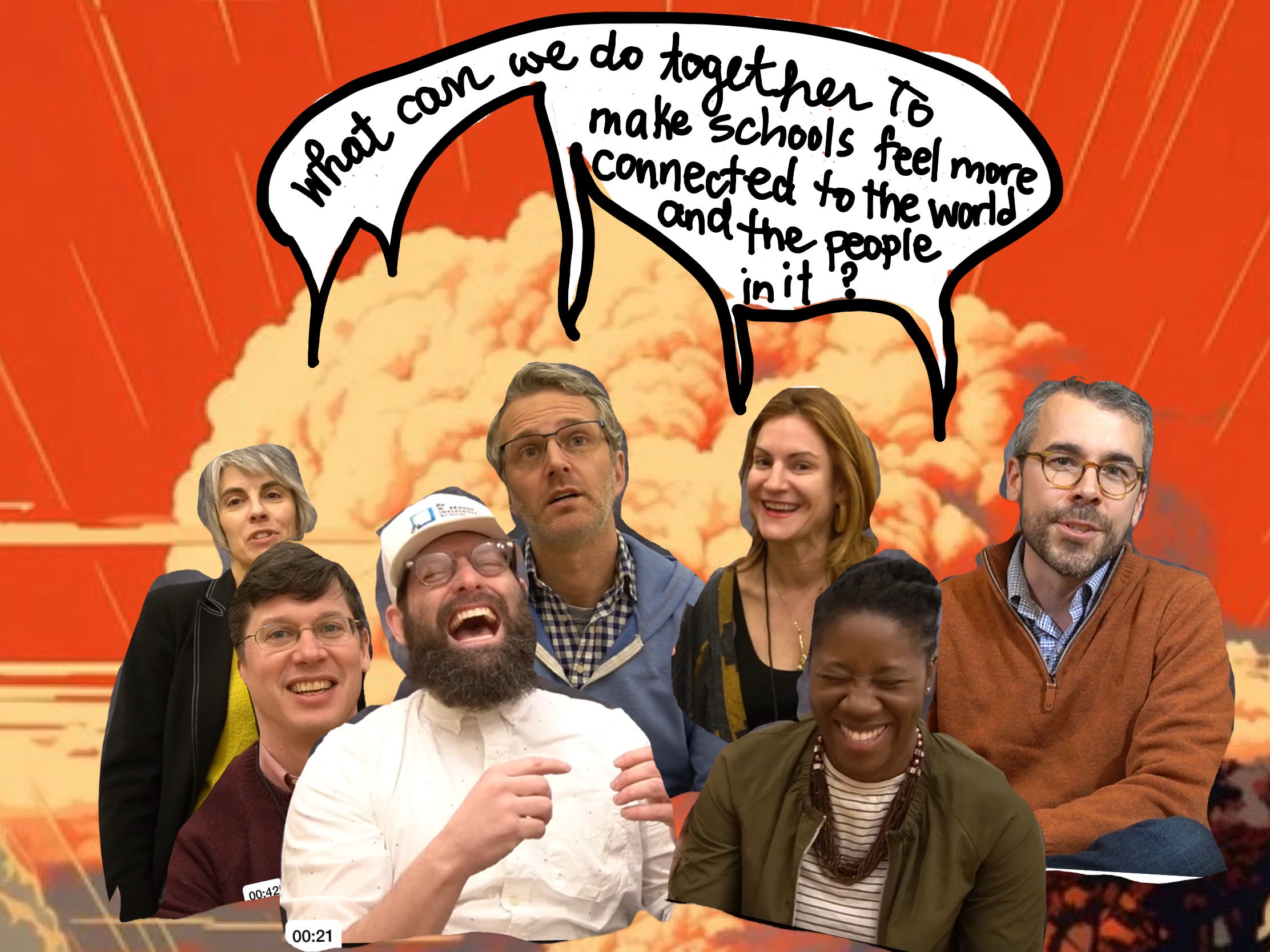
As I sit here in 2026, it’s clear that not all of those early school-starting experiments turned out as expected. Some fizzled. Some stumbled under financial pressure, leadership transitions, or the sheer gravity of legacy systems.
And yet, some persisted, all illuminating paths that still matter. The ones that did survive did not do so because they were perfect, but because they were some combination of resilient, adaptable, and brave. 1Each represented a refusal to accept schooling as inevitable, fixed, or neutral and an attempt to answer some fundamental challenges:
A system optimized for compliance over curiosity
Learning environments that confuse measurement with meaning
Schools designed for efficiency, not human development
Adults positioned as deliverers of content rather than stewards of conditions
Young people deprived of participation in shaping their own learning lives
These schools, and the broader People-Based Learning movement, didn’t emerge from ideology. They emerged from friction - educators noticing that what we were doing wasn’t matching what we said we valued.
Which raises the question that still follows me:
Did these schools fail?
Or did we simply ask the wrong question of them?
We talk about “school failure” as if schools are startups pitching investors.
What if the metric is wrong?
That question resurfaced when I recently reconnected with Chris Balme — because his career is a study in this tension.
Chris was the founding Head of School at Millennium School in San Francisco. He later served as founding principal of Hakuba International School in Japan. He is now exploring child-directed learning through homeschooling his daughter, Wren. He’s also presently writing what I know will be a profoundly useful guide to creating thoughtful advisory programs.
His experiences sit in radically different contexts ~ urban U.S., rural international, intimate family learning. And yet there is a throughline.
The same questions keep coming up across spaces:
What is developmentally appropriate here, not just academically impressive?
What conditions help young people trust themselves as learners?
How do we design environments where relationship, agency, and reflection aren’t add-ons—but the medium of learning itself?
That kind of continuity matters. It suggests this isn’t a model, it’s a way of seeing. Putting people at the center of learning is a design constraint. It forces trade-offs.
It’s People-Based Learning.
From my conversation with Chris, three key tensions emerged that align directly with the concept I’ve been co-authoring, People-Based Learning.
1. We need to move from human capital to human experience
Schools are remarkably good at sorting, labeling, and compressing people into data. Chris pushes against that instinct practically by insisting that curiosity, wandering, and reflection are not inefficiencies. They are how humans actually learn.
“I just love being an explorer… trying to get out of whatever boxes we’re lucky to notice that we’re in.”
This challenges systems that reward speed, certainty, and polish over sense-making and growth.
The bottom line: Schools are optimized for human capital.
The PeBL thread: Chris is designing for human experience.
If you want to see how exploration becomes institutional practice (not just a personality trait), Chris’s writing on school redesign is a good place to start.

People-Based Learning identifies the same process: the moments that look inefficient on paper are often the ones that change a life. The challenge isn’t convincing ourselves that curiosity matters, it’s building schools and cultures that refuse to compress it.

2. From Instruction to Participation
Chris names something many educators feel but rarely articulate clearly: we’ve built enormous capacity around teaching content, and very little around designing conditions.
“We’ve overdeveloped one muscle of being instructors… and underdeveloped the muscle of being facilitators who are concerned about conditions more than content.”
This isn’t about adults stepping back entirely, or teachers disappearing. It’s about repositioning authority so learners can practice agency, contribution, and authorship while learning is happening. It’s about what happens when responsibility is shared and co-ownership deepens.
Chris writes about this in more detail here:
3. From Culture as Add-On to Culture as Infrastructure
Perhaps most powerfully, Chris emphasizes that schools don’t become relational by adding SEL programs. They become relational when adults practice presence, listening, and shared meaning-making with one another first.
“If we start off with presence for each other… then we will build that for the students.”
Learning travels through social fields, not lesson plans.
Put another way, you can mandate curriculum, but you cannot mandate belonging.
Schools that treat culture as infrastructure tend to embed advisory, restorative practices, and adult collaboration into the daily rhythm. Check out the following:
The Morningside Center for Teaching Social Responsibility for restorative practices that are embedded schoolwide.
EL Education for advisory as a cultural backbone.
The National School Reform Faculty for protocols to structure adult listening.
What connects Millennium, Hakuba, Revolution, and People-Based Learning isn’t a shared structure. It’s a shared rejection of false binaries:
content or connection
rigor or relationship
expertise or participation
standards or humanity
Instead, these efforts insist that learning is relational, developmental, and participatory, whether it happens in a school, a family, a workplace, or a community.
We say we want innovation in education, but rarely tolerate the instability innovation requires. So perhaps the better questions are not:
Did these schools succeed? But:
What did they make visible that had been hidden?
What capacities did they cultivate that traditional systems neglect?
What risks were they willing to take publicly that others only discuss privately?
None were truly “failed” schools. Students were deeply connected, seen, elevated to co-authorship in programming. What happened was really diagnostic. The experiences showed us where the system needed attention.
Seen this way, these weren’t isolated experiments. They were early heat maps.
And we are still using them.
These schools weren’t supposed to be permanent monuments, they were probes.
They tested what happens when you treat young people as participants instead of products.
Some didn’t last, but the questions did. And if the questions are still alive, the experiment isn’t over.

This post names the questions.⬆️
The Kindred Work section that follows is where you get to walk with them.⬇️
Paid subscribers have access to this carefully selected set of podcasts, conversations, and resources that extend these ideas into lived practice, voices wrestling honestly with participation, agency, facilitation, and human development.
If you’re looking for places to think alongside rather than answers to copy, it’s there.
