

From Hot Takes to Big Talk
How disagreement can become connection, inquiry, and learning

Check it out: A convo about People-Based Learning on the Growth Over Grades podcast with Jordan Lewis out this week. Click the ❤️ to spread the word.
I learned how to disagree at my kitchen table. I thought that was what happened at kitchen tables ~ you ate dinner, told funny stories, debated current events, shared your latest hot take. My dad frequently took the opposing view simply because the conversation was getting too easy. He liked to instigate.
These memories are from before Google, before every factual dispute could be settled by reaching for a phone. We used personal experience, half-remembered stats, stories we had heard somewhere, and whatever logic might stake our ground.
It was just what we did…in my family.
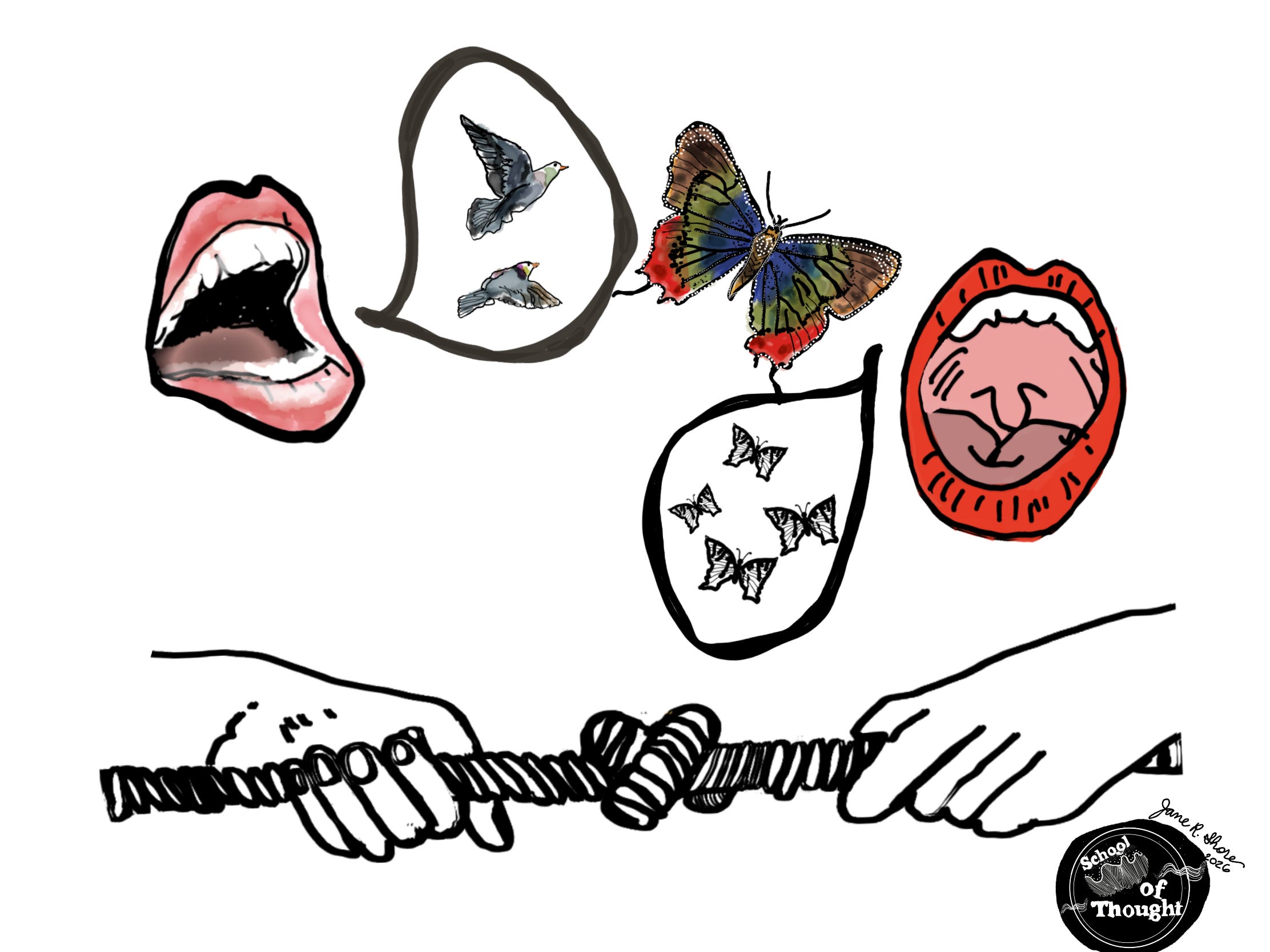
Friends sat at that table with us all the time. Some jumped right into our disagreement culture, raising new points and challenging old ones, laughing at the exchanges. Others were confused, not sure if the arguments were recreational.
I hope they understood that disagreement was my family’s love language, that no one mistook contradiction for disconnection. If anything, pushing back was a way of paying attention. You challenged someone’s idea because the relationship itself was not in question.
Disagreeing with care was how I grew up. It took me years to understand that not everyone sees disagreement this way.
The Big Idea
In grad school, I took a class in sociolinguistics with Deborah Tannen, author of You Just Don’t Understand. It was one of my most memorable classes for so many reasons. And one had to do with an article she assigned.
In “Jewish Argument as Sociability,” Tannen opened with a story about a lively Thanksgiving dinner. People debated, interrupted, talked over one another, moved in and out of arguments, and built energy through disagreement. As I read it, I remember thinking: Wait. What? This is just dinner.
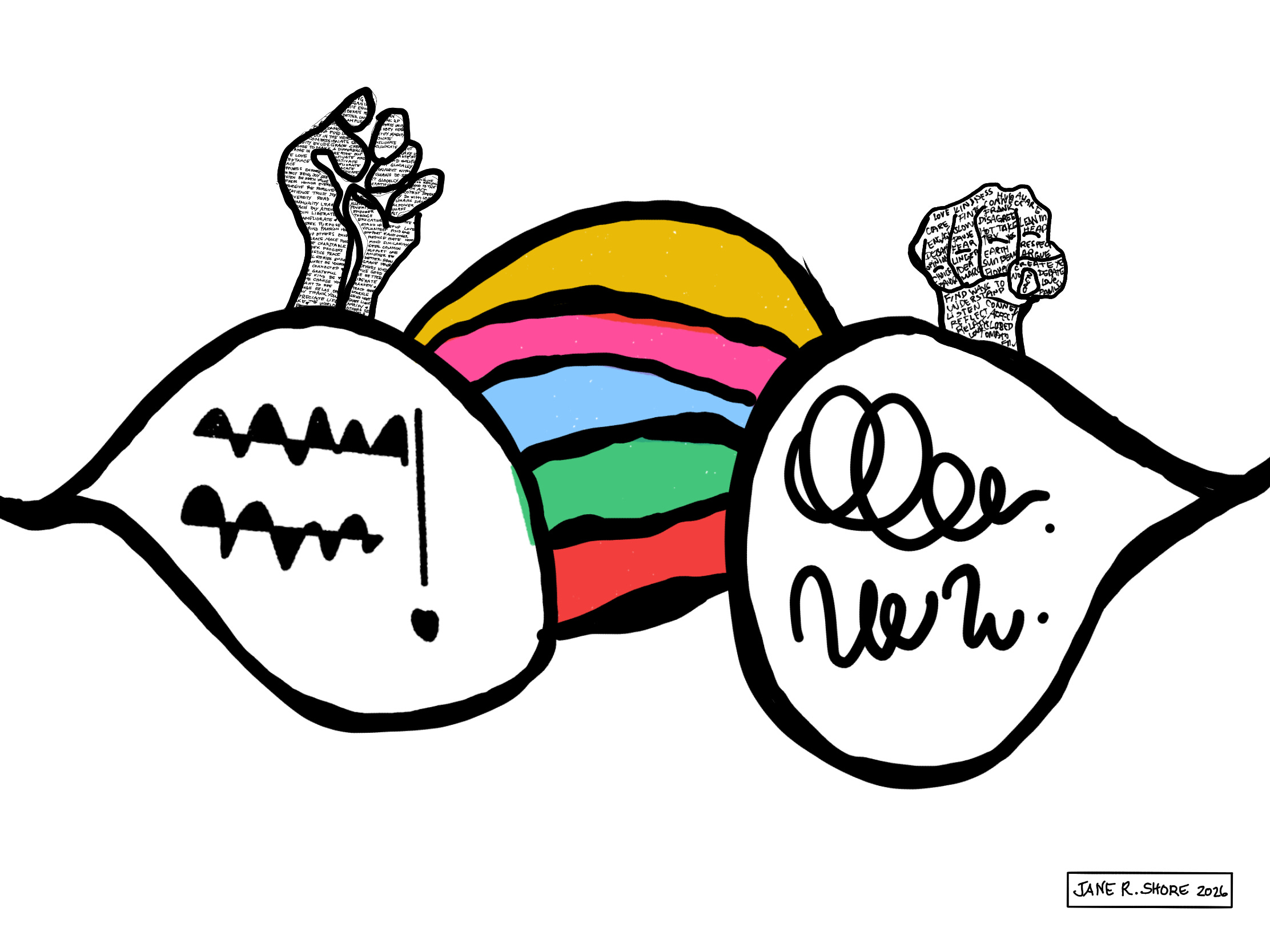
But that is the problem with having no comparison sample. And while I did not grow up religious, this disagreement culture was part of me. For some, disagreement signals engagement: I am listening closely enough to push your thinking. For others, it signals rupture: Something between us is no longer safe.
Many of us operating from entirely different theories of what an argument is. Play? Inquiry? Competition? Rejection? Care?
Perhaps that is one reason disagreement feels so combustible. We lack shared expectations for what it means. And with the ability to increase our reach with strangers, we end up practicing disagreement about something important, often without the protection of an established relationship. We are asked to withstand consequential friction without having the ordinary kind.
So in response to the times, my friend and colleague Maria Munro Schuster and I decided to do a little guided study on “disagreeing well” over the past few months. We both read Monica Guzmán’s book, I Never Thought of It That Way. We took a free online course on disagreeing well. We discussed what challenged us, and compared what each experience exposed in our own habits.
I had expected to collect a set of techniques for difficult conversations, or collect a few phrases I could recall at tense moments. Instead, I began questioning some of my deeper assumptions about disagreement.
Assumption 1: We disagree most with people we dislike.
One of my all time favorite podcast episodes was a conversation at the 92nd Street Y, Adam Grant and Malcolm Gladwell. They frequently spar, as their methodologies for claiming big things differ. And they had a compelling discussion about how we tend to truly engage, with people whose opinions we care about. Most disagreements are not worth the effort. We argue with people whose minds we respect, whose thinking has some claim on us. Indifference can be worse than disagreement.
To challenge someone can carry an unexpected compliment: I believe you are capable of thinking about this more deeply. I believe this conversation is worth having. Of course, disagreement does not always communicate respect, as we’ve seen. The difference made more clear after re-reading Guzman’s book is this: curiosity. With curiosity, disagreement says: You may know something I do not, and I care enough about what you think to stay.
Assumption 2: The point of a hard conversation is agreement.
This was a hard one for me. “Understanding one another” is often presented as the ideal outcome. But sometimes full understanding is simply impossible and the other person’s experience remains challenging to us - the gap between you doesn’t close and no one changes their position.
Maybe it’s not all about coming to some agreement. Maybe we’re asking Did we manage to disagree more accurately? It’s more like: I see your point more clearly now.1
Assumption 3: We can learn to disagree when the stakes are already high.
We tend to treat disagreement as something we learn to do in an emergency. And high-stakes conflict may be the worst possible place to practice. To disagree well,2 we need accumulated experiences of friction that do not destroy the relationship.
This week, I participated in Priya Parker’s Group Life workshop on Hot Takes. A hot take in this case is defined as a strongly voiced, low-stakes opinion. The spoon is the best utensil. Fall is the superior season. Vanilla is better than chocolate. Nothing about identity, dignity, or anything that actually needs to be resolved.
Initially, the exercise felt a little inconsequential to me. I could argue about ketchup without becoming defensive. No emotion. No stake. How could this prepare me for something that mattered?
Then we were asked to notice what happened in our bodies when someone opposed us. That question changed the exercise for me, helping me recognize that activation is not always danger. Someone contradicts us. We feel our pulse rise, the desire to interrupt, the impulse to sharpen our argument or gather allies. And then nothing terrible happens. We differ, and the relationship survives.
Each experience offers evidence: disagreement does not end belonging.
Assumption 4: If we are disagreeing well, we should feel calm.
The final assumption I revised was that calm is evidence that a disagreement is going well. Parker put a name on some calm, calling it unhealthy peace: everyone appears agreeable/calm because no one believes it is safe or worthwhile to say what they actually think.
What she suggested was that we might want to see what she calls healthy heat: enough trust to be candid, enough curiosity to remain open, and enough humor to prevent the disagreement from swallowing the relationship. See: kitchen table, above.
Something else happened during the practice ~ opinions exposed stories. An argument about eating pizza with a fork revealed that people were imagining different kinds of pizza, shaped by where they grew up. The conversation became more interesting as we encountered experiences beneath the conclusions.
Perhaps we often disagree inaccurately because we meet people’s positions without meeting the lives that produced them. Healthy disagreement does not just tolerate difference. It can make the person behind the opinion more visible.
Is disagreement thinking with another mind, and so …People-Based Learning?
Making Big Ideas Usable
So what can we do with this?
We keep asking people to disagree better about democracy, education, politics, identity, and the future. But we offer surprisingly few places to develop the capacities those conversations require, few places to engage in a kind of people-based learning that pushes our thinking forward.
Our study revealed a progression of practice that I would love to continue designing with you.
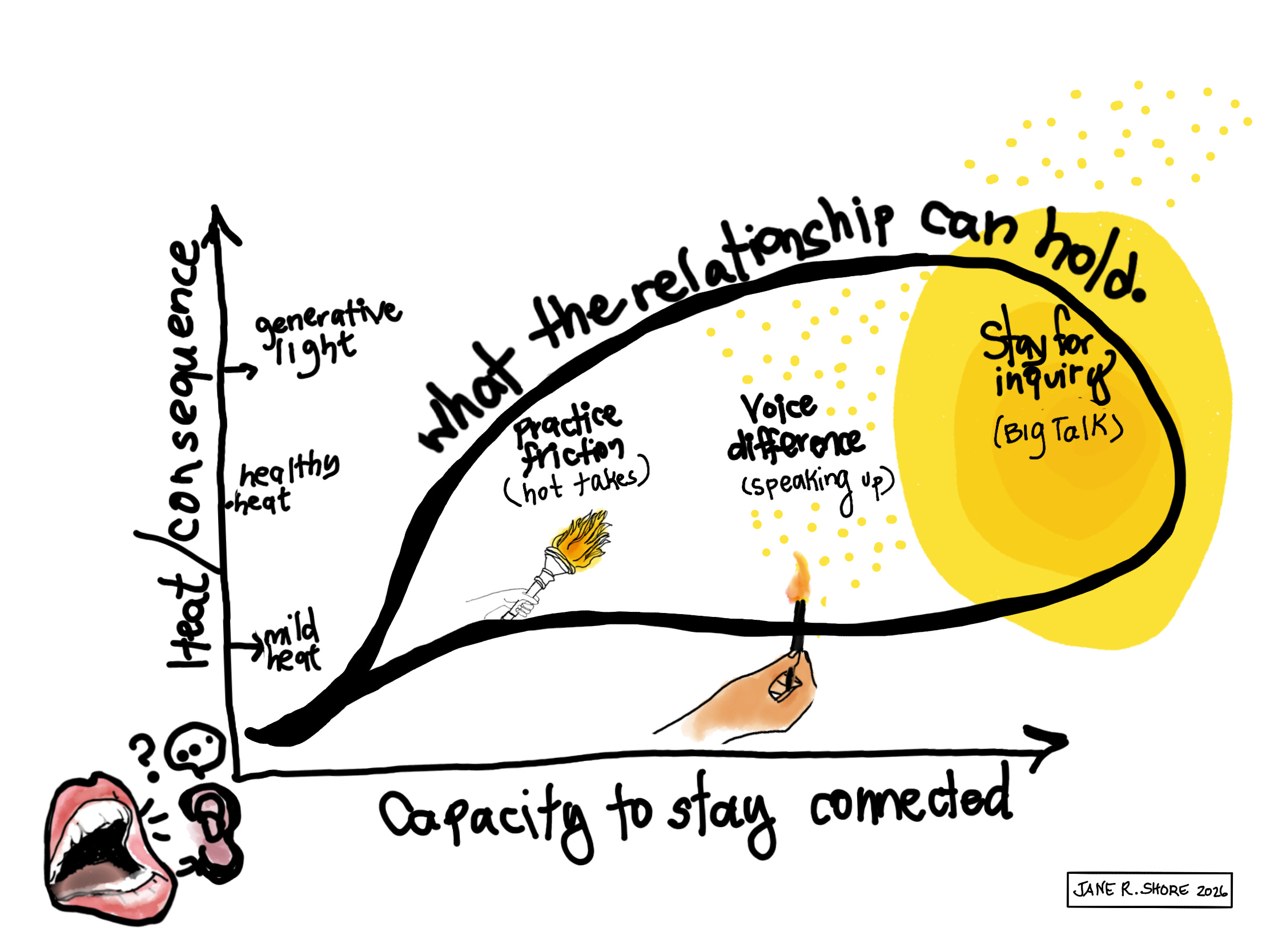
1. Begin with mild heat
Hot takes give us a place to experience contradiction without catastrophe. Cats are better pets than dogs. Breakfast food should only be eaten at breakfast. Cereal is soup.
The subject may be ridiculous, but our reactions are not entirely pretend. We (I) still feel the urge to defend, interrupt, persuade, recruit, or dismiss. Because little is at risk, we can become curious about those impulses.
What happens inside me when someone immediately rejects my position?
Can I ask a question before presenting more evidence?
Can I enjoy the energy without needing to win?
Can we differ and remain connected?
Low-stakes disagreement lets us practice holding heat before it becomes a fire.
2. Practice speaking up
The purpose is not to become exceptionally skilled at arguing about pizza. At some point, we have to risk saying something we actually believe. Speaking up sits between the playful and the polarizing. It means offering a real observation, concern, question, or dissenting view before the stakes become unbearable.
I do not think this plan will work as intended. I see the situation differently. Something important is being left out. I changed my mind after hearing that example.
I’ve been in situations in which “speaking up” was not the culture, but it needed to be. We can and need to break those paradigms. Speaking up requires more than having an opinion. It means making our thinking available to other people.
It also requires a group willing to receive the contribution as something to consider rather than something to defeat. This is where unhealthy peace becomes healthy heat. Not everyone agrees, but more of what people actually think becomes available to the room.
3. Move toward Big Talk
A few years ago, I wrote about Big Talk, a movement as an alternative to the habitual small talk through which we often pass one another.

Big Talk is sometimes interpreted as an invitation to immediate emotional exposure: Tell me your deepest fear. Describe the last time you cried (ugh). Reveal something private so we can feel close. (No.) These make me crazy. All of the sudden business gurus and psychologists alike are telling us that revealing the last time we cried is connection.
That is not part of my definition.
Big Talk is conversation organized around a question large enough to reveal how another person thinks. What have you changed your mind about? When does belonging become conformity? What is something our culture rewards that may be making us worse? What kind of knowledge can only be created between people?
These questions carry more weight than whether vanilla is better than chocolate, but they do not have to threaten anyone’s dignity or require confession.
They occupy a space between the light and the fire. They are meaningful enough to interest us, open enough to explore together, and spacious enough to hold more than one answer.
Perhaps we have confused the size of a question with the danger of asking it. A question can be big without being invasive. A conversation can matter without becoming an emergency. People can disagree about something consequential without placing one another’s humanity up for debate.3
Hot takes let us practice the feeling of being contradicted. Speaking up lets us make a real view available to the room. Big Talk asks us to remain in conversation long enough for another person’s thinking to do something to our own.
The progression is not a ladder we climb once. We may need to move back and forth. A playful argument can open into a story. A serious question may need humor to become bearable. A person may speak up and then need time before they can stay for the disagreement that follows.
But together, these forms of conversation can build a kind of relational range. We learn that we can differ without disconnecting. We learn to say what we actually think before resentment or urgency takes over. And we learn to stay with questions that may not have a single answer.
Perhaps the next School of Thought gathering should begin with mild hot takes, because it gives us a chance to notice ourselves inside disagreement.
At my kitchen table, it was not simply that disagreement was allowed. It was that ideas mattered. People said what they thought and still do. Questions grew larger. Someone pushed back, another person added a story, and the conversation became something none of us could have created alone. The relationship was not the subject of every disagreement. It was the structure that allowed disagreement to happen.
We need practice surviving contradiction. We need places where people can speak before the stakes become explosive. And we need questions worth remaining in the room for.
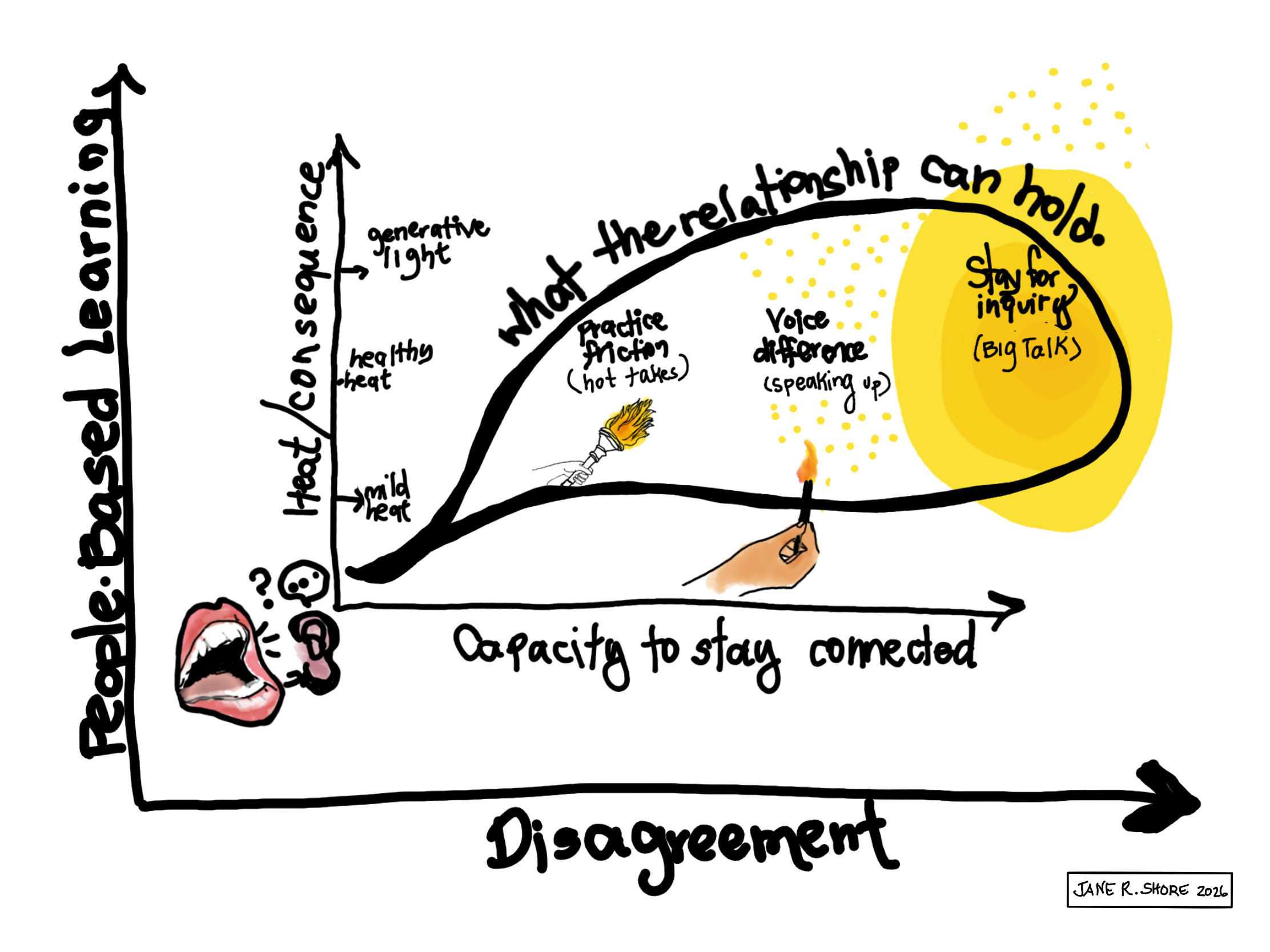
Perhaps the goal is not merely to disagree well or disagree better. It is to build conversations sturdy enough to move from playful difference (not take), to honest dissent (speaking up), to collective inquiry (big talk). We need more kitchen tables: places where the heat can rise, the questions can grow bigger, the thinking can grow sharper, and the relationship can remain intact.
.
Just Show Up: Join our PeBL learning experiment
Want to be part of an experiment intentionally designed as a space to learn with and through others? Join author and professional counselor Maria Munro-Schuster and I for Just Show Up, virtual gathering.
We will introduce a People-Based Learning practice and offer many ways to participate.
Date: Friday, August 28 Time: 1:00–2:00 p.m. ET Location: Link provided with registration Click here for details and to register. This is open to all for now.
Show up with a question. Show up with an idea. Or just show up.
I am thinking of planning our next School of Thought Just Show Up as a People-Based Learning experiment to start with Hot Takes and see where it brings us. It would be open to paid subscribers and others who want to be a part. Would you join?
Did I discover what you truly believe, rather than arguing with the simpler, more convenient version I assigned to you? Did I leave with fewer misconceptions about your motives? Can I now state your position in a way you recognize?
That is, with curiosity and grace and not so emotionally triggering that we leave feeling exhausted with our hearts emptied or so riled up it takes hours to calm down.
A reminder that we’re talking here about how to practice disagreeing well. This message is not that we should not engage in consequential discussions. It is just that we need practice so that when we do, we can feel the healthy kind of heat.
This is pure discourse analysis or, as Arab people tend to say, El-Hiwar (which means Dialogue), a more close term to people-based learning communities for sure ;-)