

People-Based Learning is Not Just About Relationships
What People-Based Learning is asking us to design

❤️Click here for a special discount this month on the People-Based Learning book.
This summer, I discovered that I may have been introducing my own idea all wrong. The discovery came through the very process the idea describes: other people helped me understand something about People-Based Learning that I had not yet seen clearly on my own.
I had begun speaking publicly about the work for the first time: my book, the framework I had developed with other educational thinkers, and a visual and research-based way of making sense of what people can add to learning. It was exhilarating. It was also unexpectedly instructive.
Because the work is personal, I often opened with a story.
I talked about growing up in a Philadelphia home where the door was always open and people gathered around the table. I talked about the things I had learned from tutors, neighbors, colleagues, students, and strangers. I sometimes told the story of arriving at college as a freshman and somehow being elected social chair of a club I had only just joined.
Then I paused and asked people what they were noticing. Their responses were warm, thoughtful, and…then I noticed a theme:
“Relationships matter so much.”
“This is about belonging.”
“Let me show you all my work in collaborative learning!”
At first, I nodded. None of those interpretations was wrong. But after hearing versions of them again and again, I began to feel uneasy.
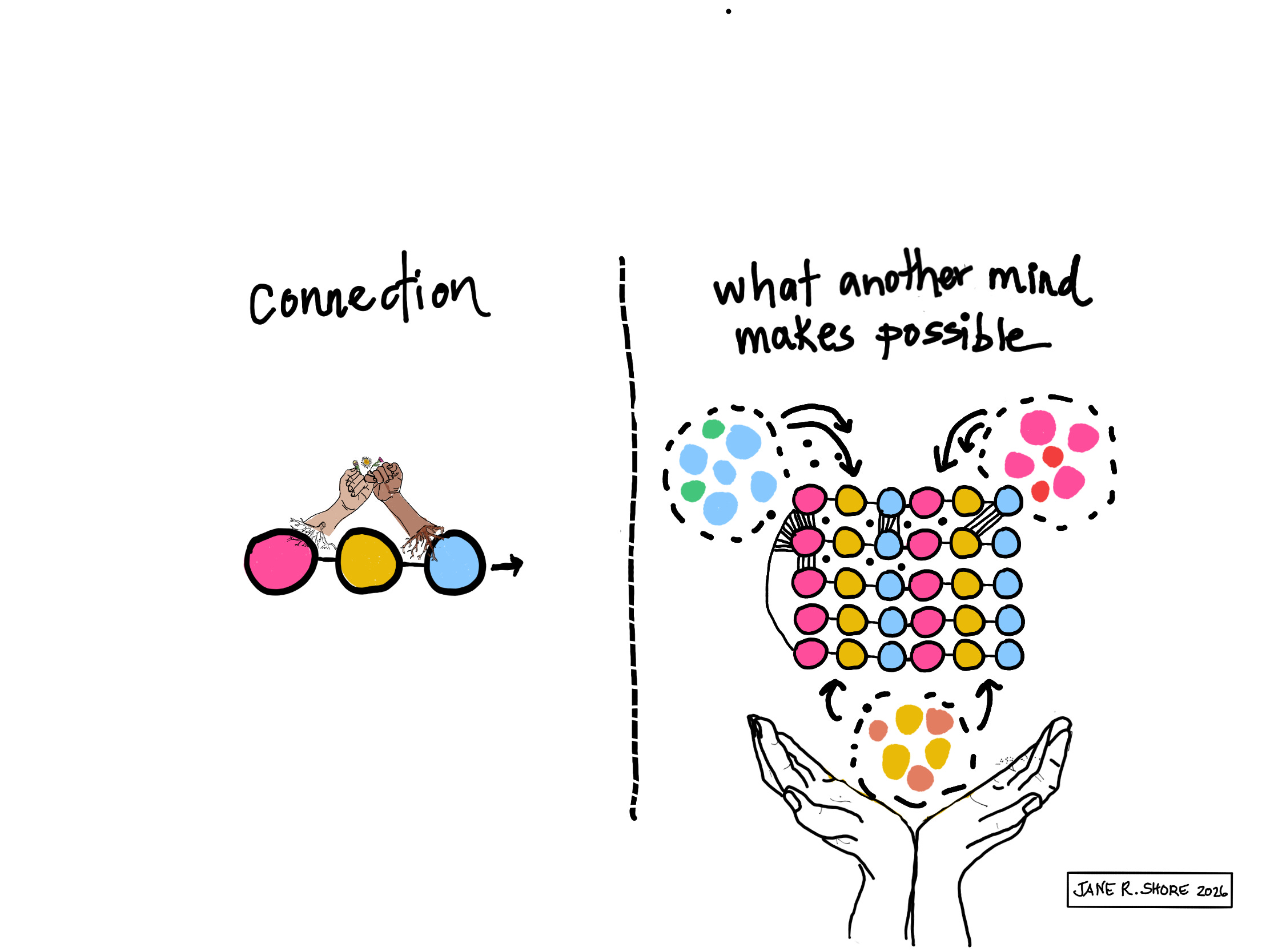
I had written a book about what other minds make possible, and my stories were leading people to believe I had written a book about being connected.
That is not quite the same thing.
People-Based Learning certainly includes relationships, belonging, and community. But those are conditions. They are not the central claim.
The central claim I hoped to convey was closer to this:
Another person is not valuable to learning simply because they make us feel supported. Another person becomes educationally necessary when their mind makes possible something our own mind could not produce alone.
A conflicting experience can expose the limits of a theory.
A question can reveal an assumption we did not know we were making.
A misunderstanding can force us to explain an idea more precisely.
A dimension that expands thinking beyond its original plane.
A group can generate an interpretation that no individual member could have reached independently.
The word people had been pulling audiences toward warmth, connection, and relationships. I needed to pull it toward cognition.
So, on a train from New York to Philadelphia in late June, I began rethinking how I explained the framework. Perhaps I needed to spend less time describing why people matter and more time asking a harder question: What can another human contribute to learning that no other resource can?
People-Based Learning isn’t an argument that every lesson should involve collaboration, or discussions in circles, or even relationships. It isn’t about doing group work, or using a particular method to hear from more voices in a classroom. It’s not about making an experience warmer, or making a relationship deeper for learning to happen. All of those are part of it, but the concept is more threaded than that.
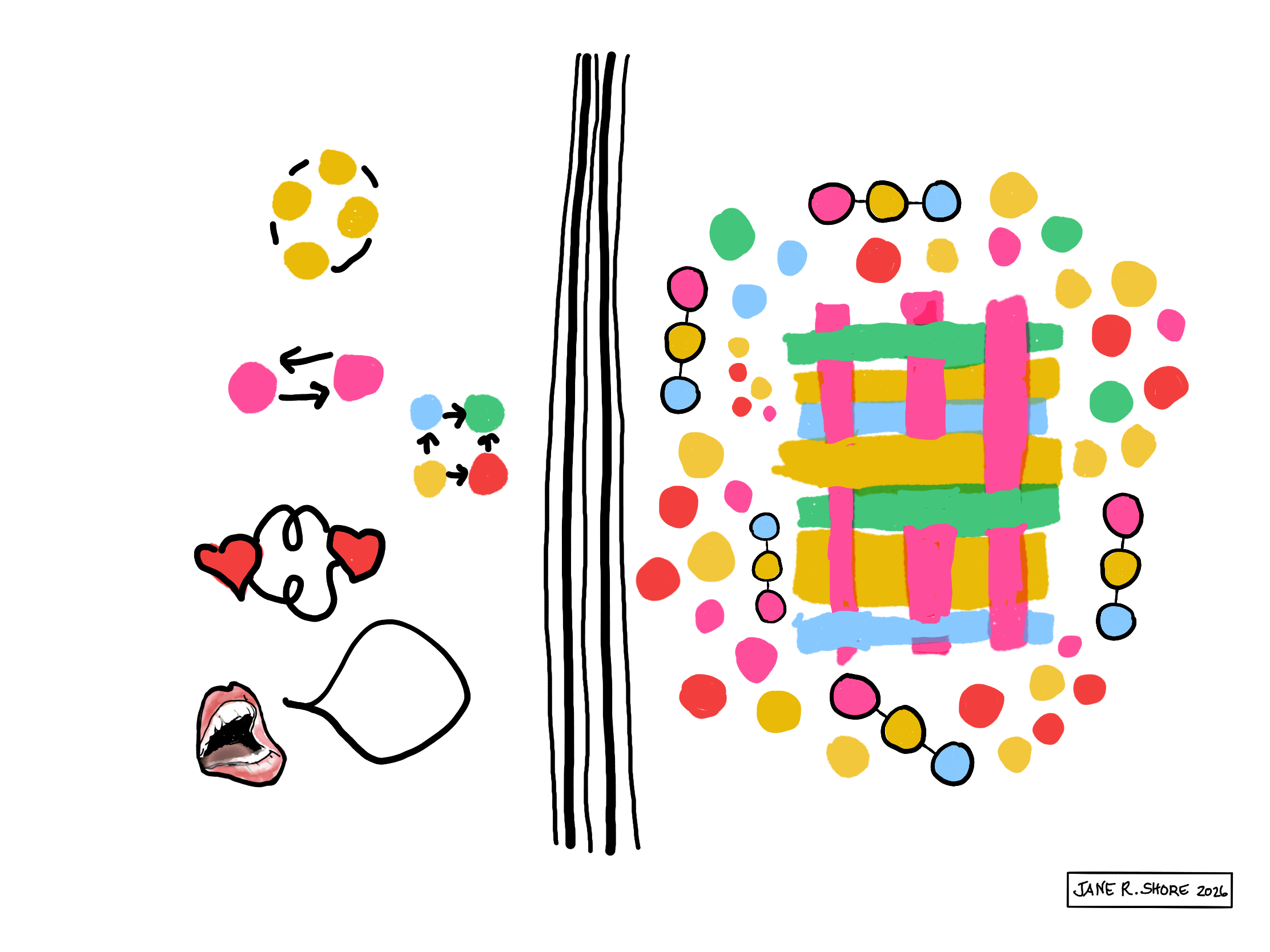
I’ve been thinking about it and feel the best way to describe what it IS is to offer some questions. People-Based Learning asks:
When might a person explain an idea in a way no other resource could?
When might someone’s lived experience expose the limits of a theory?
When might a disagreement with someone help clarify what you believe?
When might another person notice an assumption you cannot see alone?
When might a story make a concept emotionally and intellectually graspable?
When might a group produce an interpretation that none of its members could have generated independently?
These questions matter even more now that AI can act as tutor, editor, researcher, explainer, simulator, and brainstorming partner.
The important question is: What role must another human play here, and why?
That distinction matters because people are not always necessary. Honestly, sometimes the strongest design is solitude. A learner may need time to read, rehearse, write, practice vocabulary, visualize a concept, or follow a line of thought without interruption. Adding people to those moments can weaken the learning rather than improve it.
But when another human expands thinking, adds perspective, introduces friction, deepens personalization, hits emotion, then it is People-Based Learning.
Making Big Ideas Usable
People-Based Learning does not mean maximizing interaction. It means becoming more precise when human thinking is educationally necessary. Consider the difference between these two tasks:
Task A: Each student writes an argument, then exchanges papers with a partner for comments.
Task B: Each student must construct an argument that accurately accounts for a partner’s conflicting experience, respond to the partner’s questions, and revise until the partner agrees their position has been understood.
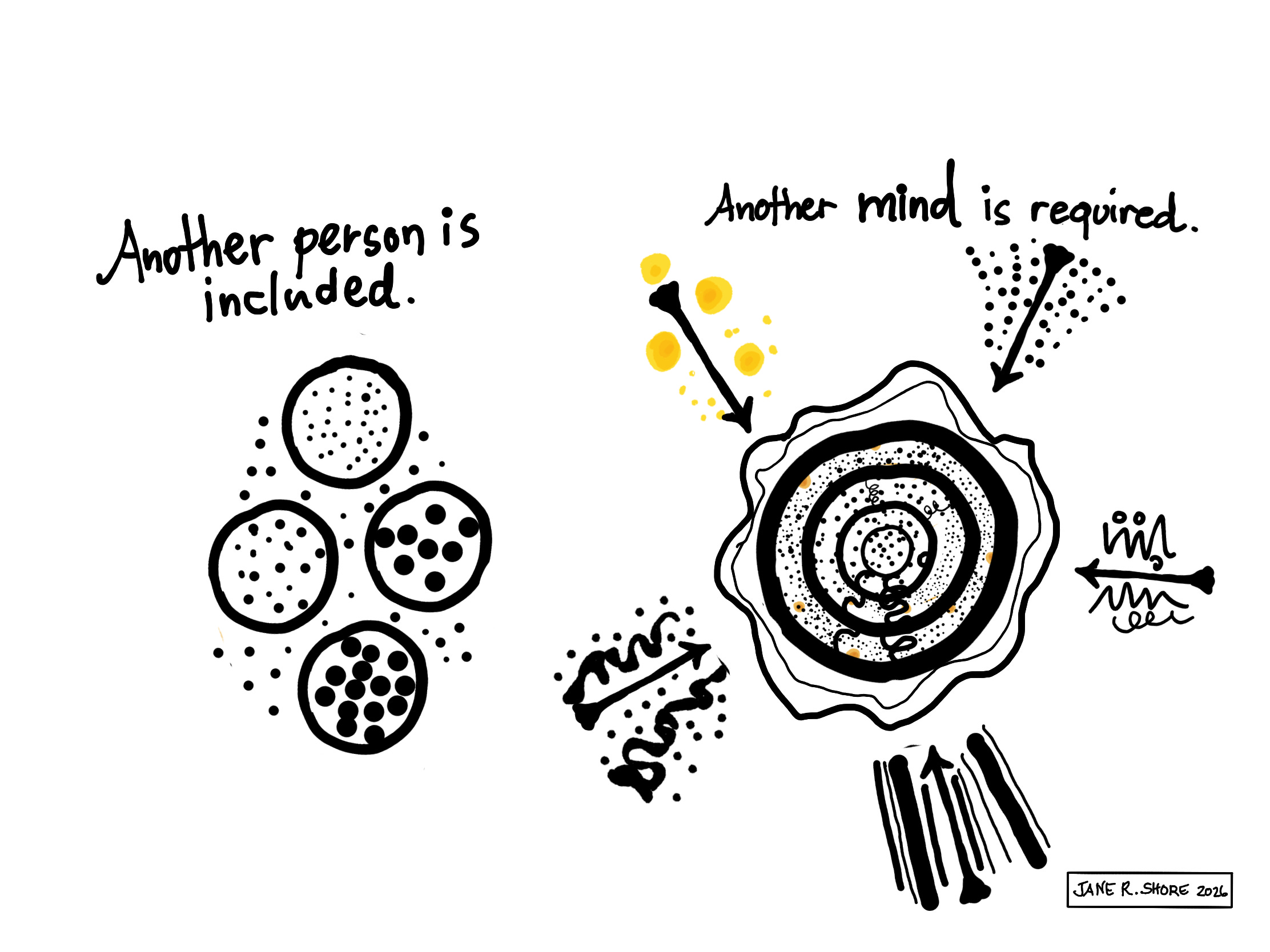
Both involve another person. Only one requires another mind. That is the distinction.
When learners are practicing how to:
explain an idea to someone who does not yet understand it
persuade without dismissing
negotiate meaning
interpret ambiguity
listen for what is not being said
revise their thinking in response to another perspective
solve problems with incomplete and distributed knowledge
create something no individual could produce alone
People are not merely supporting the curriculum. They are part of the curriculum. And that is the point.
Some forms of thinking cannot be fully developed inside a single mind. They emerge between minds.
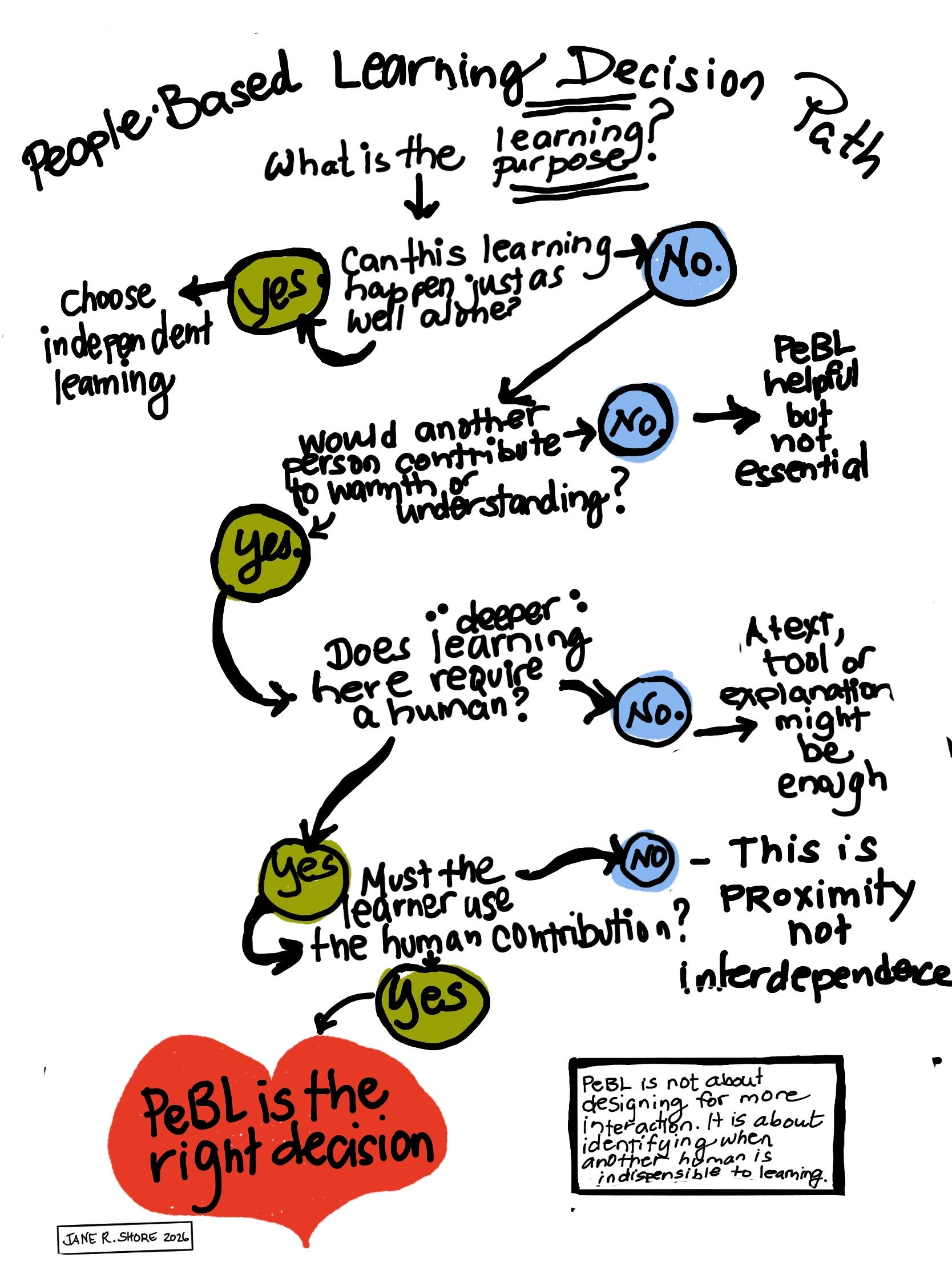
This leads to a more demanding PeBL design heuristic:
1. What is the learning that matters most?
This is not the activity or the product in the end, it is the actual human capacity or skill or experience or understanding being developed.
2. Could that capacity be developed as well alone?
If yes, independent work may be the stronger design.
3. What does another person contribute that a text, tool, or AI system cannot?
A lived experience? Misunderstanding? Friction? Judgment? Emotion? Accountability? An unfamiliar interpretation? A genuine stake in the outcome?
4. Does the task require learners to use that contribution?
Students can sit beside one another, divide the work, and never encounter one another’s thinking. Proximity is not interdependence.
5. What will make each person’s thinking consequential?
The key here is consequential. Will someone else need to respond to it, build from it, challenge it, reinterpret it, or change because of it?
Discussion protocols, peer feedback, role rotation, shared products, and reflection can help. But they are only useful when they make another person’s contribution necessary to the learning.
People do not automatically improve learning. A room can be full of people and still be cognitively solitary. A group project can contain no meaningful exchange. A discussion can leave every assumption untouched. A relationship can feel supportive without producing new thought.
People-Based Learning asks for something more specific.
PeBL asks designers to identify the moments when another human is not just part of an audience, or a helper, partner, or source of encouragement. They are part of the cognitive architecture of the experience.
People-Based Learning is not about adding more human interaction. It is about designing learning in which human difference does indispensable work.
In an age when technology can increasingly imitate explanation, feedback, conversation, and even collaboration, we all will need to become far more intentional about why people are present.
Just Show Up: Join our learning experiment
Want to be part of an experiment intentionally designed as a space to learn with and through others?
Join author and professional counselor Maria Munro-Schuster and I for Just Show Up, virtual gathering. We will introduce a People-Based Learning practice and offer many ways to participate.
Date: Friday, August 28
Time: 1:00–2:00 p.m. ET
Location: Link provided to those registered
Click here for details and registration. This is open to all and will be intentionally small at first. Show up with a question. Show up with an idea. Or just show up.
Love this Jane and have commented on LinkedIn